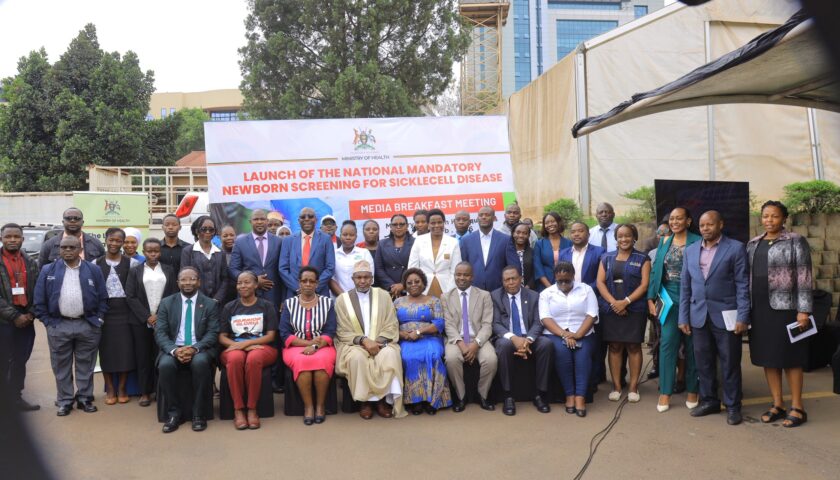

The Ministry of Health on Tuesday launched a nationwide newborn screening programme for sickle cell disease (SCD), aimed at enabling early identification of affected infants before symptoms develop and allowing for life-saving interventions.
Speaking at the launch, the Ministry of Health Permanent Secretary, Dr Diana Atwine, described the initiative as an evidence-based intervention for the prevention and control of SCD. She said government will ensure testing kits are readily available in health facilities across the country.
“We are going to make sure that we have these test kits readily available in the facilities to scale up newborn testing. We are also adding the medicine to the essential medicines list in our facilities,” Dr Atwine said, urging couples to know their sickle cell status before planning for childbirth.
“And now with the excitement of Valentine’s Day, we encourage couples to also take time to know their sickle cell status before planning for childbirth. If you both find that you are carriers, reconsider the relationship. Yes, those love feelings can be very strong… you may feel like you can’t breathe if that relationship has to end, but the risk of producing a child with sickle cell disease is too great and costly. The repercussions will outweigh that love one day,” she added.
Dr Atwine, however, cautioned that the newborn screening programme does not replace premarital screening, which remains critical in identifying carriers before marriage.
“Newborn screening complements premarital screening. It enables early identification of affected infants before symptoms occur,” she said.
She explained that early diagnosis allows timely, life-saving care, including penicillin prophylaxis, pneumococcal vaccination, and early use of hydroxyurea. This, she noted, leads to reduced infections, fewer complications such as severe anaemia and stroke, lower mortality, and better long-term organ function.
Dr Atwine added that screening also facilitates comprehensive care, parent education on warning signs, and genetic counselling, including identification of children with sickle cell trait (AS).
She further revealed that the Ministry plans to expand sickle cell disease screening to schools and institutions of higher learning so that young people know their status early and can make informed decisions when the time comes for long-term relationships.