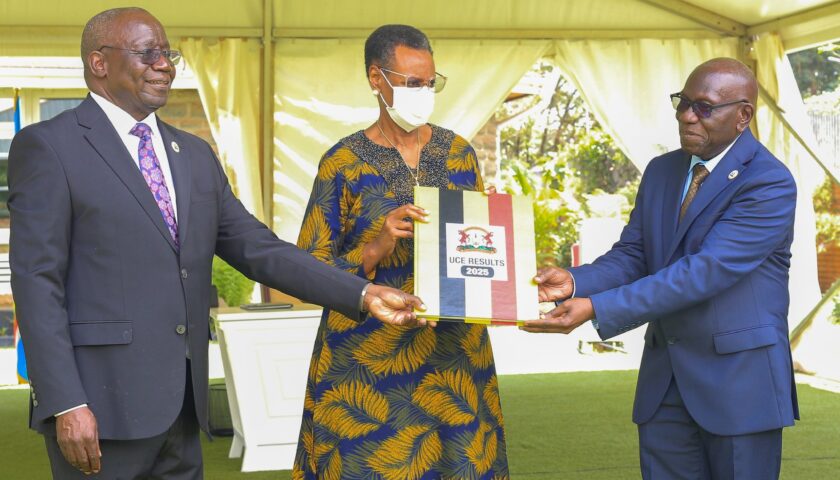

The Uganda National Examinations Board (UNEB) has today released the Uganda Certificate of Education-UCE 2025, applauding the new competency-based curriculum for equipping learners with practical skills that promote self-reliance and entrepreneurship.
Speaking during the release, Prof. Celestino Obua, the UNEB Chairperson, said the 2025 UCE results demonstrate significant progress under the Competency-Based Curriculum (CBC), highlighting improved institutional capacity and the dedication of UNEB staff.
Prof. Obua noted that whereas in 2024 Uganda National Examinations Board (UNEB) was treading on new ground, the 2025 terrain proved far more familiar, with significantly improved institutional capacity.
“I sincerely commend the Executive Director and staff for their dedication and professionalism, which has enabled the successful release of the results of the second cohort of candidates under the Competence-Based Curriculum (CBC),” he said.
“During the release of the 2024 examination results, I stated that the Competence-Based Curriculum was a good and progressive reform. This assessment was based on insights gathered through interactions with various stakeholders,” Prof. Obua added, saying that last year, the Board undertook a comprehensive study to obtain empirical evidence on the benefits of the CBC from the perspectives of school administrators, teachers, and learners themselves.
This study was further informed by your directive to address a legitimate and important question: How do learners under the CBC differ from those under the former content-based curriculum?” He said the findings provide a clear and convincing answer:
“The results confirm that the CBC is a strong, transformative curriculum, well-positioned to produce the type of Ugandans needed to drive the country’s socio-economic transformation and advance Uganda toward its middle-income status vision,” Prof. Obua raised.
He noted that learners trained under the CBC demonstrate strong research skills, can construct knowledge independently, are more creative and innovative, communicate more effectively, and show improved critical thinking and problem-solving abilities.
UNEB candidate statistics for UCE 2025
According to UNEB Executive Director, Mr. Dan Odongo, a total of 432,163 candidates from 3,975 examination centres registered for the UCE 2025 examination, compared to 359,417 candidates in 2024, representing an increase of 72,746 candidates (20.2%). Of these, 204,292 (47.3%) were males and 227,871 (52.7%) were females.
According to UNEB Executive Director, Mr. Dan Odongo, a total of 432,163 candidates from 3,975 examination centres registered for the UCE 2025 examination, compared to 359,417 candidates in 2024, representing an increase of 72,746 candidates (20.2%). Of these, 204,292 (47.3%) were males and 227,871 (52.7%) were females.
Odongo said 154,642 candidates (35.8%) were USE beneficiaries, while 277,521 (64.2%) were non-USE candidates. He added that 429,949 candidates (99.5%) were present for the examinations, with only 2,214 (0.5%) absent. Compared to 2024, where 357,120 candidates sat for the examination, absenteeism continues to decline, reflecting improved participation and retention.
He further noted that the percentage of candidates who did not qualify for the UCE certificate has declined significantly, dropping from 1.9% in 2024 to just 0.31% in 2025.
On the issue of examination malpractice, Odongo said cases remain minimal, with only 63 reported incidents. He explained that the design of the examination items under the Competency-Based Assessment (CBA) framework makes malpractice difficult. The few cases that occurred were mainly in Mathematics and practical papers in Physics, Chemistry, and Biology.
In these instances, some candidates had been given experimental results by teachers, which they simply copied. However, under the CBA framework, candidates are expected to design and conduct investigations using the provided apparatus, and when external assistance occurred, the results submitted did not match their investigation designs, clearly indicating malpractice.
“Examination malpractice at this level remains minimal, reflecting the integrity of the UCE 2025 process,” Odongo added further.
Special Needs Education (SNE) candidates
He also highlighted that 708 Special Needs Education (SNE) candidates registered for the 2025 examination, comprising 342 males and 366 females, compared to 743 candidates in 2024. The SNE candidates included 27 blind, 116 low vision, 60 deaf, 90 dyslexic, 72 physically handicapped, and 343 with other disabilities such as sickle cell anaemia, epilepsy, or circumstances like accident victims. Only 4 SNE candidates (0.6%) were absent.
To ensure accessibility and fairness, UNEB made special arrangements for SNE candidates, including Braille-format question papers for blind learners, enlarged-print papers for low vision candidates, sign language interpreters for the deaf, support personnel for physically handicapped and dyslexic learners, and an additional 45 minutes per paper for all SNE candidates. Questions were also modified where necessary to suit the candidates’ needs.
Practical skills for job creation
UNEB further praised the competency-based approach for equipping learners with practical skills that can help them earn a living after school.
Odongo explained that many candidates are now leaving school with skills such as baking, sewing, making shoe polish, and other vocational abilities that can be turned into income-generating activities. He said this is expected to reduce unemployment and empower learners to become job creators rather than job seekers.